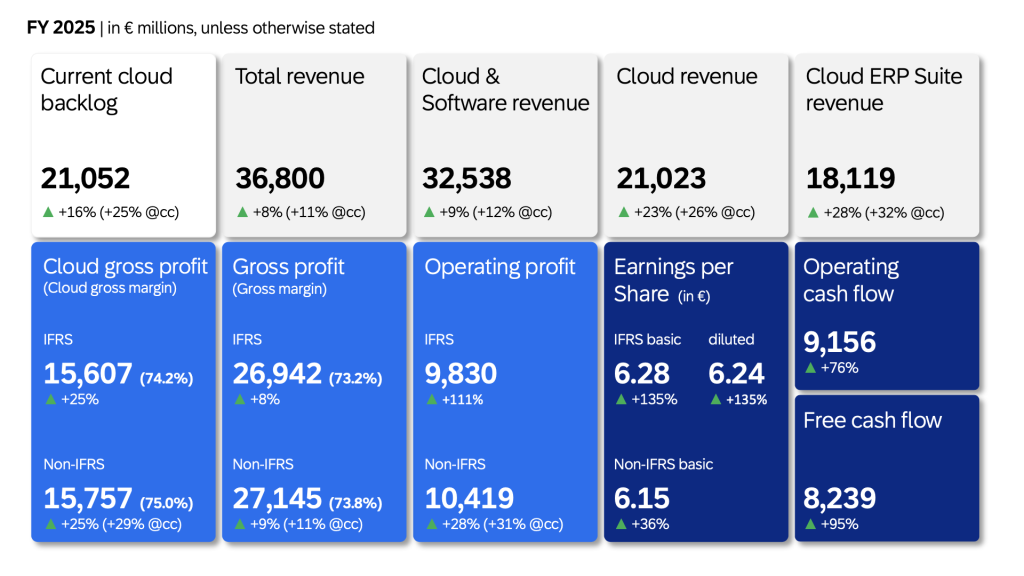

SAP has released the numbers for their financial performance for the full year and last quarter of 2025, and probably the most important fact was that cloud revenue reached €21.02 billion for the year and grew 26% at constant currency.

The Cloud ERP Suite pulled most of that weight at €18.12bn, growing faster than the rest. Top-line revenue reached €36.80bn, but the mix keeps tilting toward subscriptions, which is what finance teams like to see for predictability.

Software as a whole came in at €32.54bn and kept moving in the right direction, even as classic license sales slid to €0.99bn. That license drop (down more than a quarter at constant currency) matches what delivery teams report from the field: fewer deep core rebuilds, more standard adoption.

Services clocked €4.26bn and were basically flat after currency, a hint that more delivery is flowing through partners and packaged offers.

Put it together and 86% of revenue now shows up as predictable, which shapes how clients buy, how consultancies scope, and how they determine price.

Backlog and what it says about the next delivery wave

Though many recognize that adoption is not happening at the pace SAP would like, the backlog is long and still growing.

SAP wrapped FY2025 with €77.29bn in total cloud backlog, up 30% at constant currency, which gives partners a multi-year runway of subscription work to deliver. The near-term queue matters too: current cloud backlog sits around €21.05bn, up 25% at constant currency, so services teams should expect steady call-offs through the next few quarters.

Management pointed out that Q4 bookings set that record, and the message was simple: those ramps should lift reported revenue through 2027 as projects go live and expand.

There’s a caveat for planning: growth in the current backlog may cool a touch in 2026, so consultancies need to staff their teams with design, data, and integration soon, then be ready for heavier deployment waves later in the cycle.

One more practical note from the statement: the Cloud ERP Suite now houses platform services, finance and spend, supply chain, core HCM, commerce, transformation management, and AI under one commercial umbrella, which means value will be recognized across a wider bundle and delivery teams will need finance, platform, and process talent working in lockstep from day one.

Q4 performance

Quarter four kept the same pattern we saw all year. Cloud revenue landed at €5.61bn, up 26% at constant currency, and the Cloud ERP Suite did most of that work with €4.86bn, growing 30% at constant currency. Classic licenses shrank again (down 31% at constant currency to €452m) which narrows the window for big on-prem rebuilds.

Services came in at €1.07bn and held steady after currency, a sign that partner teams shouldered much of the heavy lifting as clients moved through deployments. With 84% of the quarter now in more predictable revenue, buyers are expected to keep asking for tight scope, quick time-to-value, and clean release paths, so delivery plans need to read like clear plans that are as easy to execute as possible.

Profitability, cash, and more stable funding

Profit flowed through more easily this year. IFRS operating profit reached €9.83bn, and on a non-IFRS basis it was €10.42bn with 31% growth at constant currency. Cloud gross margin moved up 1.7 points to 75.0%, which makes scaling the suite more financially attractive.

Cash told the same story: operating cash flow hit €9.16bn, and free cash flow jumped to €8.24bn, up 95%. With that backdrop, the board signed off a share buyback of up to €10bn running to 2027, a clear sign that cash generation looks dependable.

For partners, steady profit and cash usually translate into consistent product release schedule, predictable partner programs, and occasional tuck-in deals to fill capability gaps.

The executive commentary

Christian Klein said Q4 bookings pushed total cloud backlog up 30% to a record €77bn, and that SAP Business AI showed up in roughly two-thirds of cloud order entry. That’s the pitch consultancy clients will hear in 2026: a bigger pipeline, with AI woven into everyday ERP work.

CFO Dominik Asam added the finance view (operating profit and free cash flow came in ahead of plan) so buyers should expect steady delivery promises, tighter value tracking, and fewer detours. 

The outlook is specific: cloud revenue guided to €25.8–€26.2bn for 2026 (cc), with non-IFRS operating profit at €11.9–€12.3bn, which gives partners a clear demand envelope for the next budget year.

What the FY2025 mix means for the SAP ecosystem

Here’s the practical interpretation for anyone running a practice.

Subscriptions are now the default, which shifts delivery toward fit-to-standard ERP, side-by-side work on the platform, and a steady drumbeat of quarterly releases. That pushes partners to turn repeat tasks into packaged offers with clear scope and timing.

The Cloud ERP Suite now bundles BTP, finance and spend, supply chain, core HCM, commerce, transformation management, and AI under one deal, so process consultants and platform engineers need to sit at the same table from day one.

License revenue fell again, so the budget that once funded deep core rewrites is drying up; extension patterns that keep the core clean are likely to be much more popular. SAP’s own services line softened, which usually means more delivery moving to partners and higher expectations for reusable code, outcome templates, and reference integrations. And the record cloud backlog gives a long runway. Firms that stage design, deployment, and value realization as handoffs will grow through the next wave.

What Q4 tells consultancies about near-term demand

As expected, Q4 kept cloud growth steady and margins firm, which keeps architects busy mapping clean-core moves without hauling old custom code back into the system.

Services held flat after currency, a sign that partners carried heavier delivery while SAP kept pouring effort into the suite.

IaaS dropped hard year-on-year as the old hosted footprint shrank and SaaS and platform services took over, so skills shift toward identity, automation, and observability across multi-cloud.

When vendor gross margin improves, it usually means standardized playbooks are landing, and partners who can work within those standards and still produce measurable business outcomes will win the next set of deals.

Sector and region cues drawn from the statement

SAP listed a diverse set of customer wins and go-lives across industries and sizes, which confirms that demand is broad rather than confined to a single vertical.

The report names strong cloud revenue performance in APJ and EMEA during Q4 and cites outstanding performance in countries such as Germany, India, Italy, Spain, South Korea, Brazil, Canada, and the UK, which helps partners plan language coverage and nearshore hubs. The same section calls the Americas solid for the quarter and points to strong performance across several countries for the full year, which supports balanced hiring across regions rather than a single-market bet.

The collaboration notes around data and AI ecosystems, such as the November items and the EU AI Cloud launch, create touchpoints for platform and data practices that work alongside ERP programs. 

Practical implications for how partners build and price

Buyers are now walking in with subscription in mind, so they want tight scopes, short timelines, and clear checkpoints.

That calls for a service catalog that mirrors the Cloud ERP Suite and spells out what gets delivered each sprint. The backlog points to a solid two-year window for moves to public or private cloud with platform add-ons, so squads need functional leads and platform engineers working side by side from day one.

The cash story and buyback plan suggest a steady product release schedule, which lowers the risk of mid-program surprises and makes multi-year fixed-fee packages easier to commit to. The statement’s one-offs around litigation and workforce changes sit outside the underlying margins, and those margins look sound, which helps specialist rates hold while broad, undifferentiated roles face tougher pricing conversations.

Role-by-role outlook for individual consultants

Here’s how the talent market looks from the point of view of SAP recruitment.

Solution architects with S/4HANA Cloud under their belt will stay scarce because the suite drives the bulk of conversions from backlog to go-lives. Integration leads stay busy as event-driven patterns become standard for keeping factories, warehouses, and finance connected without pushing custom code into the core.

ABAP developers who work in ABAP Cloud and build side-by-side services keep strong demand, while deep core modification fades with each quarter. BTP engineers are involved in nearly every rollout because platform services are now part of the commercial package, so a solid API game and clean service design go a long way to securing roles.

Data specialists gain ground as AI features arrive on a quarterly drumbeat and need reliable models, contracts, and ownership rules, which puts Datasphere and cross-store designs into everyday delivery.

Test leads and change managers step into the middle of programs because release cadences turn adoption into a tracked outcome with dates and numbers. Security and identity pros see rising demand as hosted estates shrink and multi-cloud grows, bringing policy automation, access governance, and monitoring to the front of platform operations.

Architect rates should hold because backlog and suite growth support steady demand for scope design and value framing. Developer rates are likely to vary with specialization because platform and test automation command premiums while generic build faces pressure from standardized assets.

Permanent hiring inside client teams will rise in data and integration, which adjusts partner roles toward shorter, high-impact sprints and managed updates after go-live. Contract roles will stay common in markets with flexible rules, which favors partners that maintain bench pools with clear playbooks and reusable code.

Junior hiring will work best when firms give new starters safe paths to contribute within three months, which protects the talent pool when demand spikes. 

A simple reading

Taken altogether, in 2025 cloud kept climbing, margins widened, and cash piled up, so subscription ERP with platform work attached now feels like the default path for clients. Q4 kept that beat, which gives partners confidence to staff for a predictable stream of migrations, extensions, and post-go-live improvements.

The backlog adds a long runway, so it’s worth investing in repeatable methods, shared code, and small squads that can move from design to deployment without losing speed. Customer experience still splits between cloud movers and on-prem holdouts, which keeps advisory work valuable and puts a premium on clear scope, clean data, and measurable adoption.

The guidance brackets next year’s demand in a way finance teams can plan around, and that stability helps firms hold rates for scarce skills while using packaged offers to keep delivery tight. 

Individual consultants will find roles tied to clean-core ERP, platform services, data quality, testing, and change will see steady demand, while deep core modification will keep fading.

If you build around those trends, the next two years should bring full diaries and solid careers.

If you are an SAP professional looking for a new role in the SAP ecosystem our team of dedicated recruitment consultants can match you with your ideal employer and negotiate a competitive compensation package for your extremely valuable skills, so join our exclusive community at IgniteSAP.

Share